

MUSHROOM PRODUCTION, TRAINING AND LIVELIHOOD DEVELOPMENT
With the objective of promoting nutritious food, supplementary income and sustainable livelihood opportunities among rural communities, the Mushroom Production Section of VIB focuses on the development and dissemination of suitable mushroom cultivation technologies. Mushroom cultivation has considerable potential as a rural enterprise because it requires relatively limited space and investment, can utilise locally available agricultural residues, and provides a nutritious food product with good market potential.
A major emphasis of the programme is on the standardisation and dissemination of feasible, low-cost and location-specific production technologies, particularly those that can be adopted by small and marginal farmers, rural youth, women, Self-Help Groups (SHGs), producer groups and aspiring rural entrepreneurs. The programme covers the complete production cycle, from selection of suitable strains and preparation of growing substrates to spawn inoculation, crop management, harvesting, post-harvest handling and marketing.
Training and Capacity Building on Mushroom Production
Training on mushroom production is one of the major activities of the Section. VIB conducts practical, need-based training programmes for rural people, farmers, women, SHGs, unemployed youth and rural entrepreneurs to enable them to establish mushroom cultivation as a supplementary or independent income-generating enterprise.
The training programmes are designed with a strong emphasis on hands-on learning and practical demonstration rather than only theoretical instruction. Participants are trained in:
The training programme is intended not merely to impart technical knowledge but to develop competent mushroom growers and rural entrepreneurs who can independently undertake production and gradually expand their activities into viable micro-enterprises. Wherever possible, VIB also provides post-training technical guidance and handholding support to trained entrepreneurs to help them overcome production-related difficulties and improve their productivity and profitability.
The training approach also encourages the formation of mushroom producer groups, SHGs and small enterprise units, thereby facilitating collective procurement of inputs, production, processing, packaging and marketing. This creates opportunities for employment and income generation, particularly among rural women and youth.
Quality Spawn Production and Germplasm Conservation
For the successful development of mushroom enterprises, availability of quality spawn of suitable strains is essential. VIB therefore maintains a collection of good-performing mushroom strains and undertakes activities related to their maintenance, multiplication and supply of quality spawn to growers.
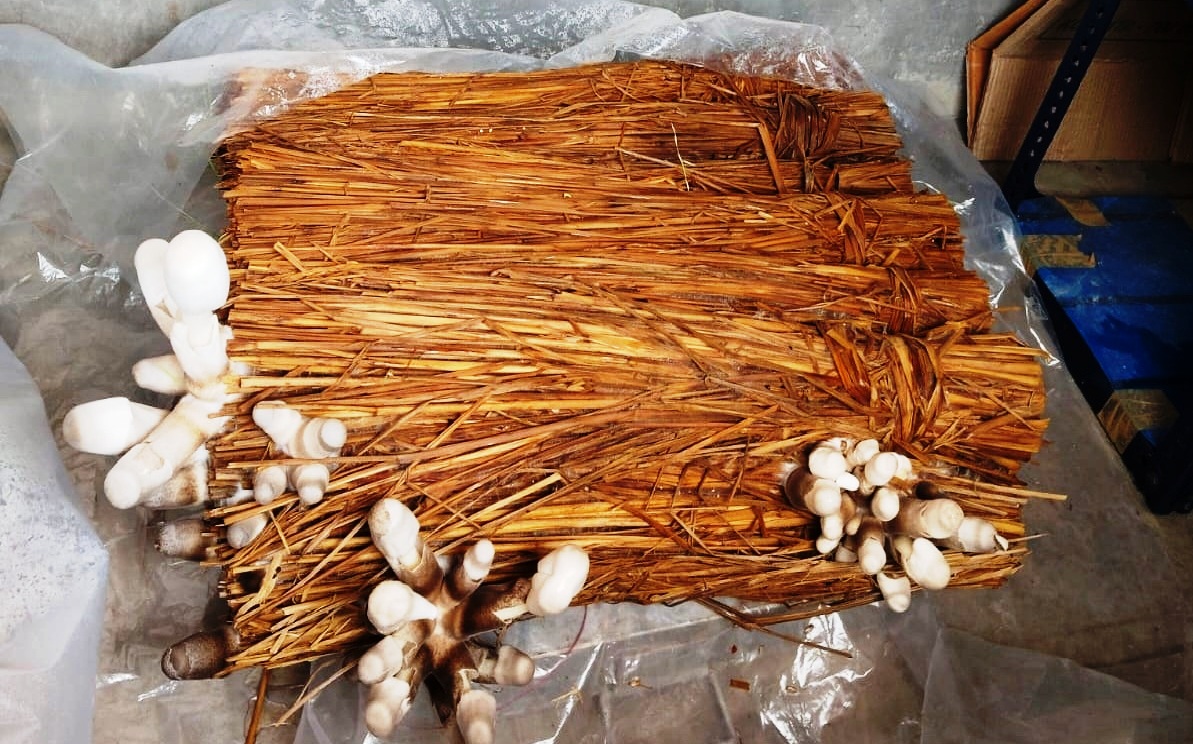
At present, the laboratory maintains 24 mushroom strains belonging to four genera—Pleurotus, Volvariella, Calocybe and Agaricus. The maintenance of this germplasm provides an important resource for research, technology standardisation, training, demonstration and production of quality planting material in the form of mushroom spawn.
The availability of reliable spawn enables trained growers to maintain consistency in production and contributes to better crop performance and product quality. VIB also continues to explore improved strains and production protocols suited to local agro-climatic and market conditions.
Organisation of Mushroom Production and Market Linkages
The Section follows an integrated approach in which technology development, training, quality spawn supply, production organisation and market linkage are treated as interconnected components of mushroom enterprise development.
After training, potential growers and entrepreneurs are encouraged to undertake organised production with technical support from VIB. Efforts are also made to facilitate market access so that growers can obtain better returns from their produce. Particular attention is given to developing local and institutional markets and to promoting value-added products, which can extend shelf life and reduce losses during periods of excess production.
FOOD PROCESSING TECHNOLOGY AND VALUE ADDITION
Recognising that value addition is an important component of sustainable rural enterprise development, VIB has established a food processing unit in association with the Sarada Swabalambi Mahila Group. The unit serves both as a training and production facility, particularly for rural women, enabling participants to acquire practical skills in food processing, preservation, packaging and small-scale enterprise management.
Training and production activities include preparation of value-added products such as jam, jelly, pickle and sauce using locally available agricultural and horticultural produce, including mushroom, tomato, chilli, brinjal, mango, pineapple, guava, orange and mixed fruits.
Special emphasis is given to the processing and value addition of mushrooms, which are highly perishable. Converting fresh mushrooms into processed products can help reduce post-harvest losses, extend shelf life, diversify the product range and create additional income opportunities for mushroom growers and women's groups.
Integrated Approach to Rural Enterprise Development
The combined activities of mushroom production, quality spawn supply, practical training, entrepreneurship development, production organisation, market linkage and food processing provide a comprehensive platform for promoting mushroom-based rural enterprises.
Through these interventions, VIB aims to transform mushroom cultivation from a small-scale household activity into a technically sound and commercially viable livelihood enterprise. The programme particularly seeks to empower rural women, youth, farmers, SHGs and producer groups by providing them with the technical skills, quality inputs, enterprise knowledge and market orientation required to establish sustainable income-generating activities.
The long-term objective is to strengthen a complete mushroom value chain—from quality strain and spawn production → farmer training → scientific cultivation → harvesting → processing and value addition → packaging → marketing—thereby contributing to improved nutrition, employment generation, women's empowerment and sustainable rural livelihoods.