

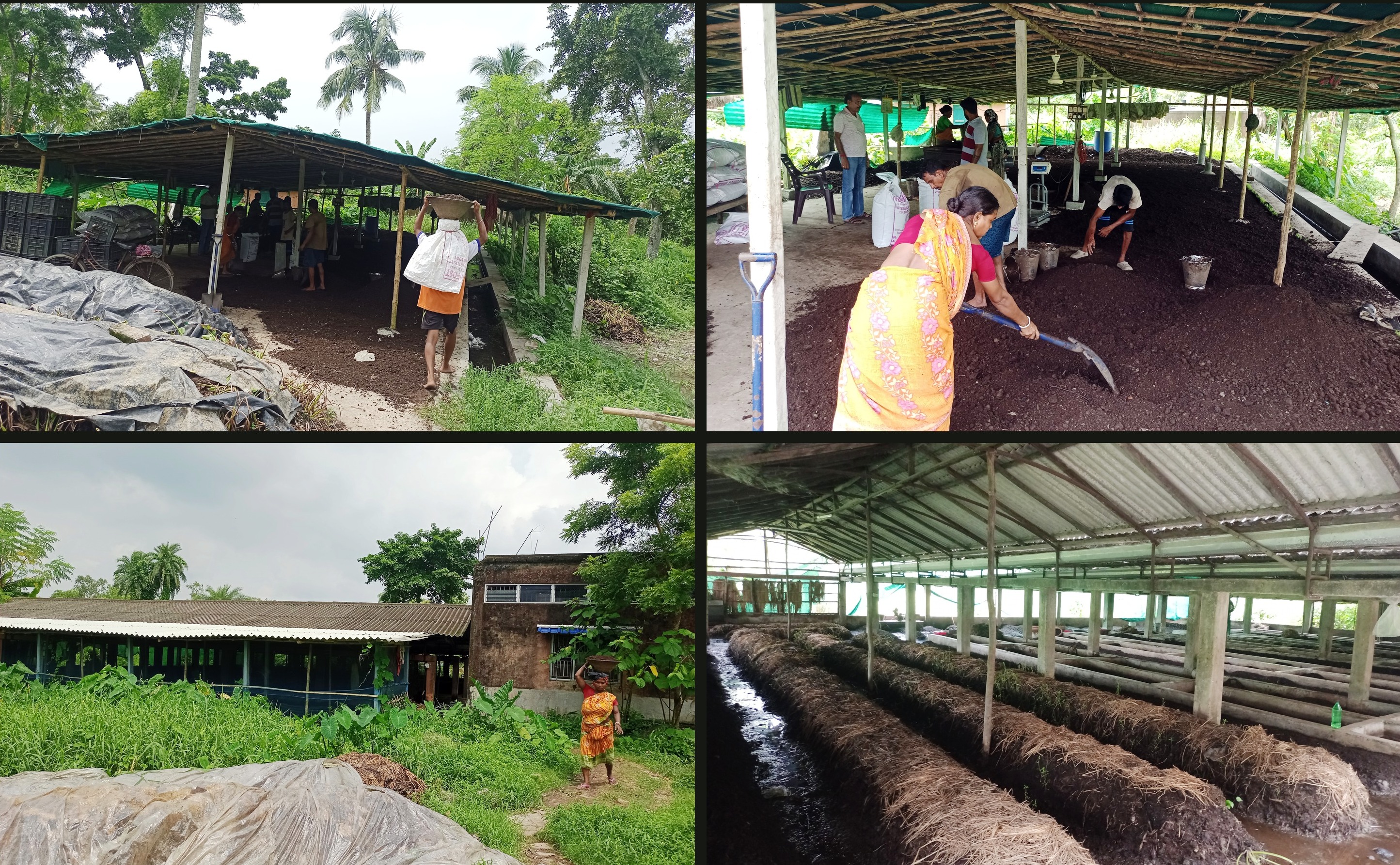
Vivekananda Institute of Biotechnology (VIB) has developed and promoted an integrated approach combining biofertilizer technology, vermicomposting and biogas-based organic waste management for improving soil health, nutrient availability and sustainable agricultural productivity. The approach is based on the understanding that soil organic matter is a critical factor influencing the establishment, activity and effectiveness of beneficial microorganisms used as biofertilizers. Vermicompost, being a nutrient-rich, biologically active and economical source of organic matter, provides an effective means of improving soil conditions and enhancing the efficiency of biofertilizer applications.
Under this integrated system, biogas production is linked with vermicomposting to facilitate efficient recycling of farm and household organic wastes. The biogas slurry generated as a by-product of anaerobic digestion contains a rich microbial population and partially decomposed organic matter. It is utilized as an inoculum and pre-decomposition medium for organic wastes prior to vermicomposting, thereby accelerating the initial decomposition process and improving the suitability of the material for earthworm-based decomposition. This integrated process converts locally available organic wastes into valuable agricultural inputs while reducing waste accumulation and promoting circular resource use.
The vermicomposting process is further enhanced through the use of selected earthworm species, which efficiently transform partially decomposed organic materials into fine, stable and nutrient-rich vermicompost. In addition to vermicompost production, VIB promotes the collection and utilization of vermiwash, a liquid extract obtained from the vermicomposting system and containing various biologically active compounds and plant-growth-promoting substances. Appropriate application of vermiwash to crops can support plant growth, vigour and productivity, thereby providing farmers with an additional low-cost biological input.
This integrated technology offers multiple benefits by recycling organic wastes, improving soil organic matter, enhancing microbial activity, reducing dependence on external chemical inputs and increasing the availability of locally produced organic and biological fertilizers. It is particularly relevant for small and marginal farmers because the system can utilize locally available biomass and farm wastes, requires comparatively low external inputs and generates multiple useful outputs, including biogas, vermicompost and vermiwash.
With support from the Khadi and Village Industries Commission (KVIC), VIB undertook awareness-building, training and promotional activities on vermicomposting and sustainable organic resource management. These interventions significantly increased awareness and adoption of vermicompost production among farming communities and other stakeholders. Demonstrations and capacity-building activities helped beneficiaries understand the preparation, management and application of vermicompost and vermiwash, as well as the potential for converting locally available organic wastes into valuable agricultural resources.
As a result of these efforts, vermicompost production has expanded substantially, and the material produced through the initiative has been supplied to different parts of the Sundarbans as well as other regions. This has contributed to wider dissemination of organic soil-management practices and strengthened the availability of quality organic manure for sustainable crop production.
VIB maintains an earthworm germplasm collection comprising three important vermicomposting species:
The maintenance of these earthworm species provides a valuable biological resource for vermicomposting research, technology demonstration, farmer training and large-scale promotion of sustainable organic waste management.
Overall, VIB's integrated biofertilizer–vermicompost–biogas approach represents a circular, low-cost and environmentally sustainable model of nutrient management, linking waste recycling with soil health improvement and enhanced agricultural productivity. It demonstrates how biological technologies can be integrated to create a self-reinforcing system in which organic wastes are converted into useful energy and high-value agricultural inputs, thereby supporting sustainable livelihoods and climate-resilient farming systems.