
The major emphasis of all activities of VIB is the delivery of appropriate technology to rural communities, with entrepreneurship serving as the principal vehicle for this technology transfer. VIB therefore continuously strives to develop a strong ecosystem for entrepreneurship development, motivation, training, incubation and enterprise support. The Institute promotes the concept of social business, encouraging individuals to form groups and develop sustainable business activities that generate both livelihood and social benefits.
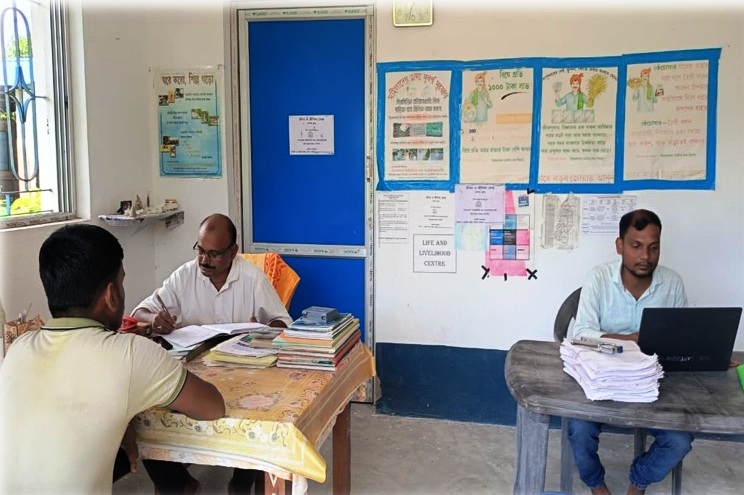
The Jibon-o-Jibika Kendra (JOJK) has been developed as an important grassroots platform in this model. JOJKs act as local centres for connecting rural communities with VIB’s technologies, products, services, training and knowledge resources. They help identify local needs and entrepreneurs, facilitate technology dissemination, provide technical and business support, and strengthen linkages among farmers, rural entrepreneurs, producer groups, financial institutions and markets. In this way, JOJKs serve as an important bridge between VIB and the village economy, ensuring that technologies developed through VIB’s research and development activities reach the intended beneficiaries in a sustainable manner.
The real challenge lies in reaching farmers in a sustainable manner with products and services developed through research initiatives at VIB and other institutions. VIB has therefore developed a rural delivery model based on VIB- JOJK- Village Resource Centre-Master Farmers-Farmers, which can commercially channel products and services to farmers through Master Farmers and other trained rural entrepreneurs. The KSKs constitute an important last-mile link in this delivery mechanism and help establish long-term relationships with farmers in the operational villages.
The scope of marketing of products such as mushrooms, honey and bee-based products, vermicompost, bio-inputs and other rural products needs to extend beyond villages to towns and major urban markets. VIB therefore recognizes the need to professionalize its marketing system and strengthen institutional support for commercialization. While VIB’s technical units and centres primarily focus on applied research, product development and continuous improvement of processes and technologies, specialized support is required for marketing, market linkage, branding and commercialization. Similarly, farmers and rural entrepreneurs require assistance in accessing remunerative markets for their products. In this context, the Rural Marketing and Entrepreneurship Development Programme (RMEDP) Cell plays an important role in coordinating and driving entrepreneurship, commercialization and market development initiatives.
VIB undertakes a range of programmes to promote and strengthen rural entrepreneurship:
The present JOJK–KSK–Master Farmer–RMEDP framework builds upon this experience by creating an integrated village-level ecosystem in which technology, training, finance, production, entrepreneurship and marketing are brought closer to rural communities. The ultimate objective is to establish self-sustaining village institutions and entrepreneurs capable of delivering knowledge, products and services while generating dignified and sustainable livelihoods.