

Plant Tissue Culture, Hardening and Production of Quality Planting Material
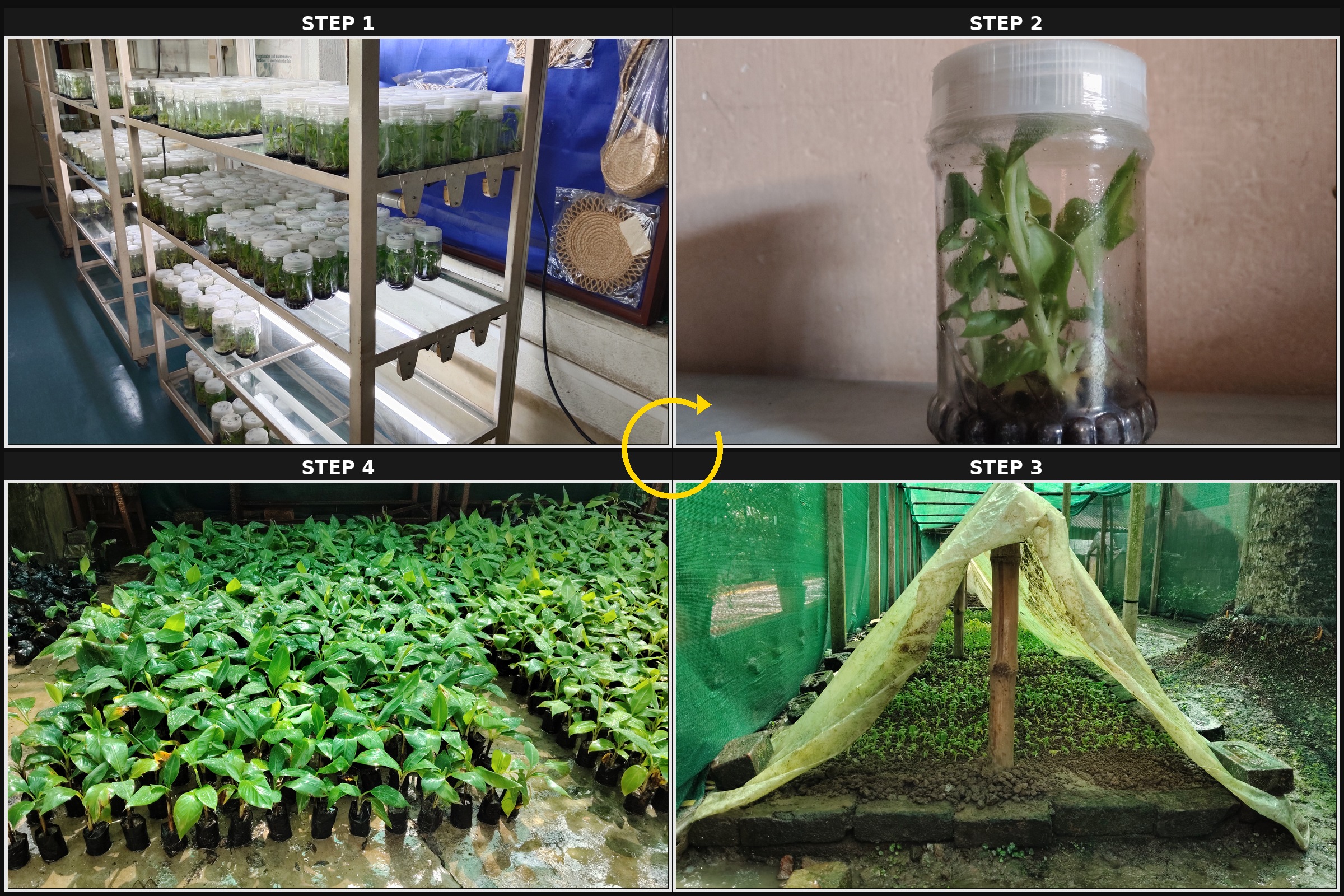
Micropropagation is one of the most efficient methods for rapid multiplication of banana plants, particularly for the production of large quantities of healthy, uniform, disease-free and quality planting material. It also provides an effective means of conserving and maintaining a number of elite and commercially important banana varieties within a limited laboratory space. The programme for the production, hardening and supply of tissue-cultured banana plantlets is continuing at the laboratory with emphasis on producing robust plantlets that are capable of successful establishment under field conditions.
At present, the laboratory maintains the germplasm of 14 banana varieties, representing a valuable genetic resource for research, multiplication, conservation and dissemination. The varieties maintained include Baischada Kachakela, Martaman, Giant Governor, Robusta, Red Banana, Pachanandan, Rasthali, Monthan, Nendran, Kanai Bansi, Chatim, Kanthali, Amrit Sagar and Dwarf Cavendish.
Hardening and Acclimatization of Tissue-Cultured Plantlets
Special emphasis is being given to the hardening and acclimatization of in vitro-produced plantlets, as successful transfer from controlled laboratory conditions to the open field is a critical step in commercial micropropagation. Plantlets produced under in vitro conditions are delicate and require gradual adaptation to external environmental conditions, including variations in temperature, humidity, light intensity, nutrient availability and microbial exposure.
The hardening programme is therefore designed to progressively develop strong root and shoot systems, functional leaves, improved photosynthetic capacity and greater tolerance to field conditions. Plantlets are initially subjected to primary hardening under controlled or protected conditions, followed by secondary hardening under progressively more open environmental conditions. Appropriate growing media, irrigation, shade management, nutrition and plant protection measures are adopted during this process.
The objective is to produce vigorous, healthy and well-acclimatized banana plantlets with a strong root system, capable of surviving transplantation shock and establishing rapidly after plantation in farmers' fields. Only properly hardened and field-ready plantlets are intended for supply and plantation, thereby improving field survival and reducing losses after transplantation.
Experiments were also conducted to study the effect of vermiwash application on the survival, growth and vigour of banana plantlets during the primary hardening stage. The study was aimed at exploring the potential of locally available organic inputs for improving plantlet establishment and growth during acclimatization.
Standardisation of Micropropagation Protocols
The laboratory has undertaken systematic studies on different stages of banana micropropagation, including shoot initiation, multiplication, rooting and subsequent acclimatization. Various concentrations and combinations of plant growth regulators were tested using Murashige and Skoog (MS) medium for banana to determine their effects on shoot initiation, multiple shoot formation and root development.
The optimum hormone concentrations and the appropriate auxin-to-cytokinin ratios were re-evaluated and re-standardised wherever necessary. The improved protocols have been incorporated into the production process with the objective of increasing multiplication efficiency and obtaining healthy plantlets with better rooting and subsequent hardening performance.
Dendrobium Micropropagation
In addition to banana, the laboratory is also engaged in micropropagation research on Dendrobium. Different hormone concentrations and combinations were evaluated using Vacin and Went (VW) medium to study the growth, shoot development and rooting behaviour of Dendrobium plantlets.
The studies are intended to optimise the culture conditions and develop reliable protocols for multiplication and production of quality planting material. The work also contributes to strengthening the laboratory's expertise in tissue culture techniques for commercially important horticultural and ornamental plants.
Papaya Micropropagation
The programme on the in vitro production of papaya plantlets was evaluated from both technical and economic perspectives. The study indicated that large-scale commercial production through tissue culture would involve relatively high production costs because of the multiple stages required for acclimatization and the comparatively slow multiplication rate of papaya under the conditions studied.
Consequently, commercial-scale production of papaya plantlets through the developed protocol was not considered economically viable at this stage. However, research on papaya micropropagation is being continued for academic and scientific purposes, with the possibility of further protocol refinement and cost reduction through improved multiplication and acclimatization techniques.
Future Focus
The overall focus of the tissue culture programme is to develop cost-effective, reproducible and scalable protocols for the production of quality planting material, with particular emphasis on banana. Greater attention will be given to improving the hardening process, evaluating suitable organic and bio-inputs, strengthening root development, reducing mortality during transplantation, and producing field-ready plantlets with high survival potential.
The programme will ultimately support farmers and nursery enterprises by providing healthy, uniform and properly hardened planting material suitable for direct plantation and successful establishment in farmers' fields, while simultaneously contributing to the conservation and utilisation of valuable banana germplasm.